The Meta Andromeda update marks one of the biggest transformations in the history of digital advertising. For years, Meta’s ad ecosystem revolved around micro-audience targeting—where advertisers manually segmented users by interests, age, demographics, and behaviors. But that era is now coming to an end.
With the Meta Andromeda campaign structure, Meta has replaced granular control with AI-driven ad targeting that learns, predicts, and optimizes better than humans ever could. This new system prioritizes automation, signal quality, and creative diversity over manual targeting lists.
For marketers, this change isn’t optional—it’s essential. Understanding how Meta Andromeda changes Facebook ad targeting will determine who thrives in 2026’s advertising landscape and who gets left behind.
The End of Micro-Audience Targeting
For over a decade, micro-audience targeting was the backbone of Facebook advertising. Advertisers would craft dozens of ad sets targeting hyper-specific segments—say, “men aged 25–30 in Mumbai interested in sneakers.” This precision made sense when data access was vast and user behavior was predictable.
However, the world of digital advertising has changed. Privacy laws like GDPR and Apple’s iOS tracking restrictions drastically limited the data Meta could use for precise targeting. As these signals weakened, campaign performance became inconsistent.
Meta began hinting at this shift through updates like Advantage+ Shopping Campaigns and broad targeting recommendations. These were the early indicators of the Meta advertising update 2026, where Meta officially moved away from manual segmentation to algorithmic intelligence.
Now, instead of instructing the platform who to target, advertisers provide broader signals—like conversion goals and creative inputs—allowing the Meta AI algorithm to find the best people automatically. The message is clear: the era of micro-targeting is over, and the age of AI-driven automation has begun.
What Is Meta Andromeda?
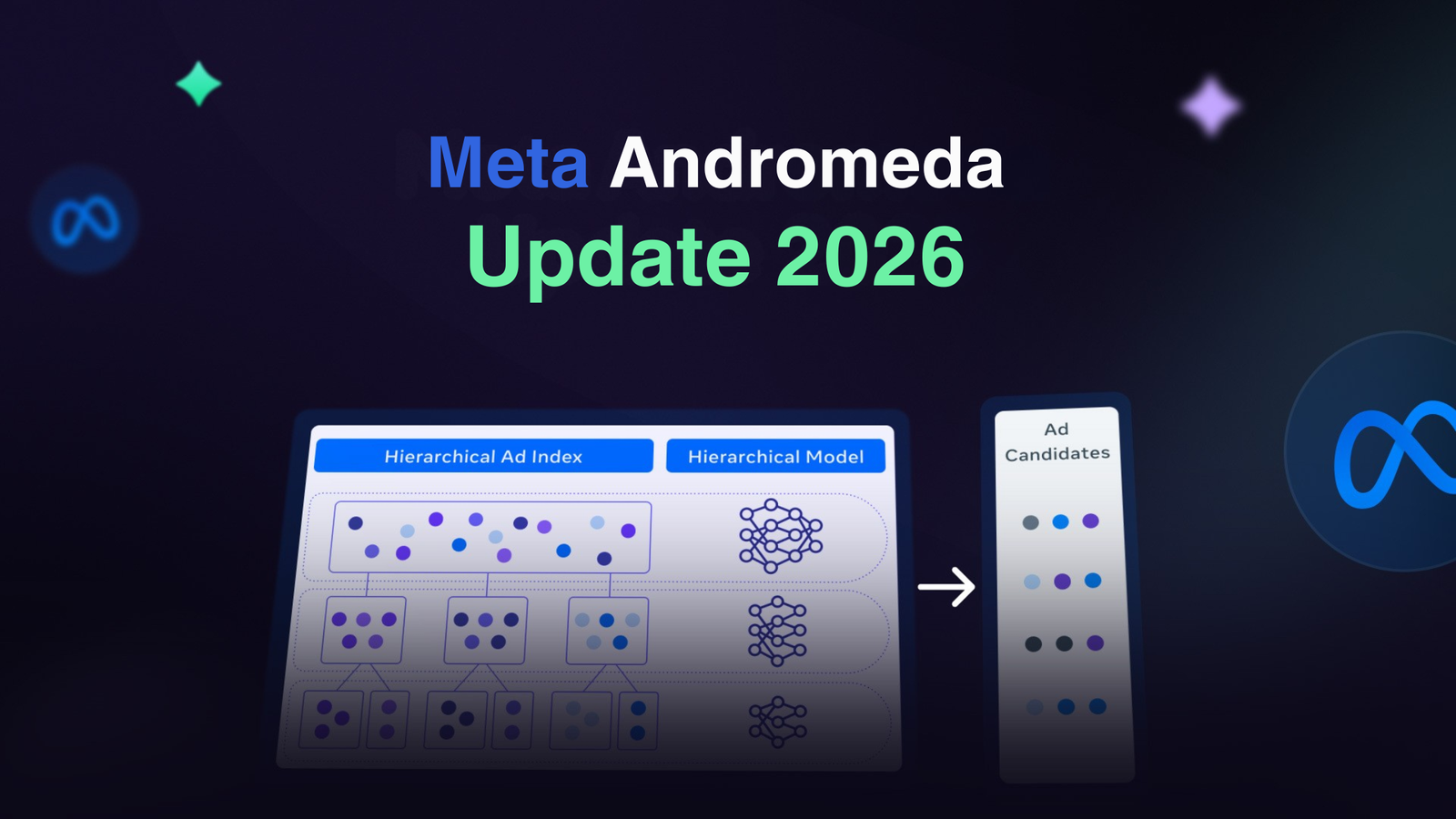
The Meta Andromeda update is Meta’s most advanced step toward complete automation in digital advertising. At its core, Meta Andromeda is a sophisticated AI algorithm designed to unify campaign management, optimize creative delivery, and simplify advertiser workflows.
Instead of dozens of fragmented ad sets, the Meta Andromeda campaign structure consolidates campaigns into fewer, data-rich systems. The algorithm learns from aggregated user interactions, pixel data, and conversion signals to predict which ad will perform best for each person—without needing explicit targeting rules.
Essentially, Andromeda acts as a predictive engine. It identifies intent, tests variations in real time, and delivers ads to audiences most likely to convert. The more data it gathers, the smarter it becomes.
Beyond targeting, Andromeda also enhances creative testing, attribution modeling, and budget optimization—making campaigns more efficient and adaptive. In short, Meta Andromeda doesn’t just change how we target; it redefines how we structure, deliver, and scale advertising altogether.
How Meta Andromeda Changes Facebook Ad Targeting
So, how does Meta Andromeda change Facebook ad targeting in practice? The biggest difference lies in who controls the audience—human marketers or AI.
Previously, advertisers manually created multiple campaigns to test different audiences. For example, a fashion brand might run separate ad sets for “college students,” “working professionals,” and “parents.” Each had its own budget and optimization rules.
Under Meta Andromeda targeting, all those micro-segments merge into one broad campaign. Advertisers define the conversion goal (e.g., purchase), and Andromeda’s AI dynamically identifies which users—across demographics and interests—are most likely to buy.
This shift to AI-driven ad targeting eliminates the need for audience micromanagement. Instead, the focus is on feeding the AI accurate conversion data and strong creative signals.
In tests reported by Meta, consolidated campaigns using Andromeda saw up to 20% better ROAS and 30% lower cost per result compared to traditional segmented setups. It’s a clear signal that automation, when powered by a smart algorithm, outperforms even the best manual targeting strategies.
Best Campaign Structure for Meta Andromeda
Adapting to the best campaign structure for Meta Andromeda requires rethinking how you build and optimize campaigns. The new structure favors simplicity, creative diversity, and data accuracy over complexity.
Here are key practices to follow:
- Consolidate Campaigns: Merge similar ad sets into a single, broader campaign. The algorithm performs better when it has more data volume to learn from.
- Diversify Creatives: Use multiple ad variations—video, carousel, static, and Reels. The Meta AI algorithm analyzes engagement patterns to prioritize the best-performing creatives.
- Strengthen Data Signals: Ensure that your Meta Pixel and Conversion API (CAPI) are properly set up. Accurate event tracking is critical for Andromeda’s predictive modeling.
- Optimize for Conversions, Not Clicks: Let the AI identify intent rather than relying on top-funnel vanity metrics.
- Allow Learning Time: Avoid making frequent edits. Andromeda’s strength lies in pattern recognition, which improves as it accumulates data.
For small businesses and agencies, this means fewer campaigns to manage and more time to focus on content and creative strategy. The Meta Andromeda campaign structure is built to reward advertisers who simplify rather than over-segment.
The Role of AI in Modern Ad Delivery
The rise of AI-driven ad targeting has completely reshaped the role of marketers. Instead of manually deciding who sees what, the Meta AI algorithm continuously learns from millions of data points—user interactions, browsing behavior, purchase intent, and creative engagement—to deliver the right message at the right moment.
This automation offers several advantages:
- Improved ROAS (Return on Ad Spend) through smarter delivery and optimization.
- Reduced manual workload, allowing marketers to focus on strategy.
- Faster learning cycles, enabling campaigns to reach efficiency quickly.
In essence, Andromeda acts as both a data scientist and campaign manager—analyzing trends in real time and adjusting delivery automatically. The result is ad personalization at scale without the inefficiencies of manual targeting.
Action Plan: How Marketers Should Adapt
To thrive in this new ecosystem, marketers must adapt quickly. Here’s a concise action plan to future-proof your advertising strategy under Meta Andromeda targeting:
- Update Your Conversion API: Ensure accurate event tracking between your website and Meta’s servers.
- Consolidate Campaigns: Merge overlapping ad sets to give Andromeda more data to learn from.
- Diversify Creatives: Test multiple formats and messages; AI thrives on creative variation.
- Focus on Data Quality: Clean up pixel setups, prioritize meaningful conversion events, and verify domains.
- Monitor AI Performance Metrics: Track optimization phases, learning periods, and signal health rather than surface-level metrics like CPC.
By embracing this change, advertisers can leverage the full power of automation and gain long-term efficiency. The Meta advertising update 2026 isn’t just a technical adjustment—it’s a strategic evolution. Those who adapt early will enjoy better scalability, reduced costs, and stronger campaign insights.
Conclusion
The Meta Andromeda update officially signals the death of micro-audience targeting and the birth of AI-first advertising. Instead of chasing hyper-specific segments, marketers must now master the art of feeding AI systems with strong data and creative diversity.
Adopting the best campaign structure for Meta Andromeda is not just about following new rules—it’s about evolving with technology. As Meta’s ecosystem continues to lean into automation, success will depend on how effectively you collaborate with AI, not compete with it.
So, take the lead—experiment with broad targeting, refine your signals, and stay ahead by testing Andromeda’s full potential in your next ad campaign.